



RevoluSun Blog
The July 4, 2026 Commercial Solar Deadline: What Businesses Need to Know

Kelley Burke
31 January 2026
As interest in commercial solar continues to grow across Hawai‘i, many business owners are hearing about an important federal deadline coming up on July 4, 2026. This date is tied to the 30% Federal Investment Tax Credit (ITC), but the reality is more nuanced than a single cutoff.
For experienced installers and developers, the real constraints arrive much earlier. Equipment availability, construction capacity, and internal planning timelines all play a major role in whether a project can move forward smoothly—or at all.To help clarify what this means in practice, we will break the timeline into three planning zones: Green, Yellow, and Red
Why July 4, 2026 Matters
To qualify for the full 30% federal ITC, commercial solar projects must either:
- Begin construction, or
- Meet Safe Harbor requirements (typically by spending at least 5% of total project costs) by July 4, 2026.
Meeting this requirement is powerful, it locks in the 30% ITC and provides up to four years to complete construction. Missing it doesn’t necessarily end a project, but it compresses timelines, increases risk, and reduces flexibility. The key takeaway: while July 4 is the legal deadline, the practical deadline depends on how early planning begins.
The Three-Zone Commercial Solar Timeline
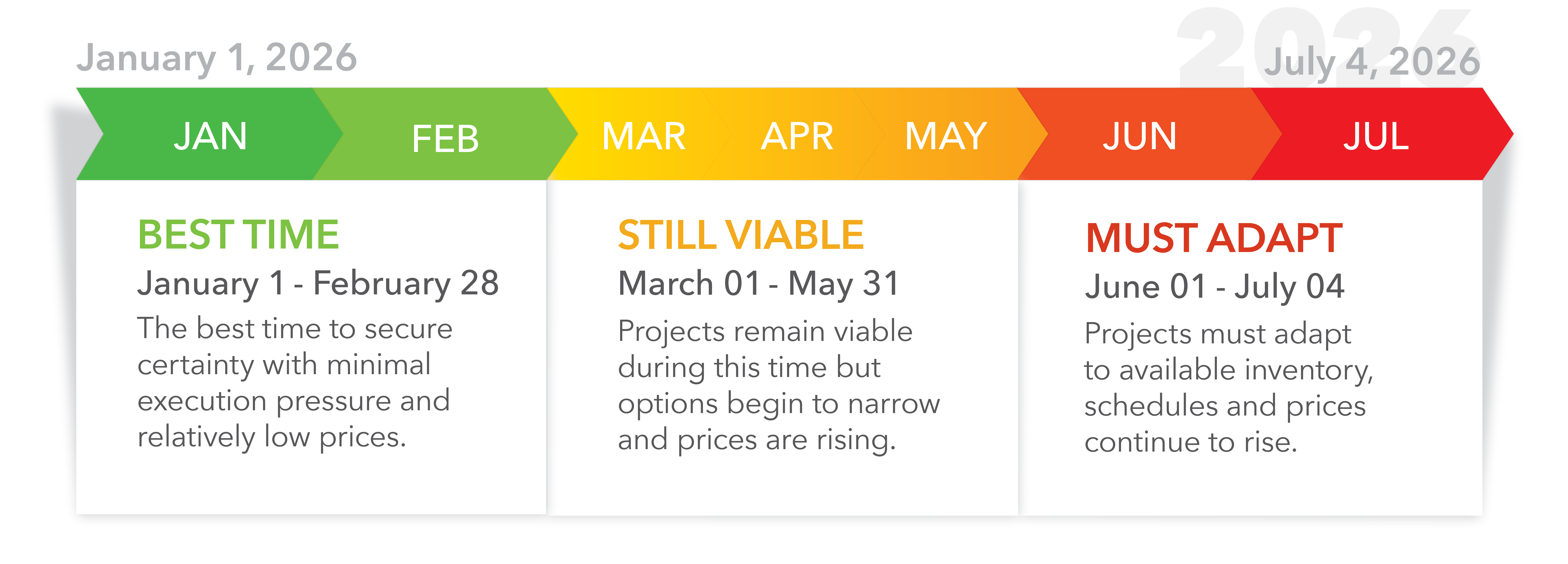
Green Zone: Best Time to Plan (January–February 2026)
The Green Zone is when projects have the most flexibility and lowest risk.
During this period:
- Project schedules are more open
- Equipment options are widest
- Pricing is typically more stable
- Internal planning can happen strategically, not reactively
February sits firmly in this Green Zone, making it an ideal time for businesses that are even considering commercial solar in the next few years to start planning.
Yellow Zone: Still Viable, But Narrowing (March–May 2026)
Projects can absolutely still move forward in the Yellow Zone, but with tradeoffs.
What changes:
- Installer and construction schedules begin to fill
- Equipment availability becomes more limited
- Pricing pressure starts to increase
- Less room for redesigns or internal delays
At this stage, early decisions matter more. Delays can quickly push projects into higher-risk territory.
Red Zone: Must Adapt (June–July 4, 2026)
The Red Zone is where projects face the most constraints.
In this window:
- Schedules are tight
- Inventory options may be limited
- Pricing is at its highest
- Projects often need to adapt to what’s available rather than what’s ideal
While some projects can still meet Safe Harbor requirements, this phase requires fast execution and tolerance for higher risk.
Why Early Planning Reduces Risk
Safe Harbor is not just a date on the calendar—it’s a process shaped by:
- Equipment procurement timelines
- Engineering and permitting
- Construction labor availability
- Internal decision-making cycles
Early planning allows businesses to:
- Preserve pricing
- Secure better scheduling windows
- Reduce execution risk
- Maintain optionality as conditions change
This is why many experienced developers treat the Green Zone—not July 4—as the real planning deadline.
How RevoluSun Helps
RevoluSun works with commercial customers across Hawai‘i to guide projects from early feasibility through construction. Our team helps businesses understand:
- Whether Safe Harbor makes sense for their timeline
- How internal planning affects eligibility and risk
- What steps can be taken now—even if construction is years away
The goal isn’t to rush projects, it’s to plan them intelligently, with full visibility into incentives, timelines, and tradeoffs.
Next Steps
If you’re considering a commercial solar project, our team is here to help you move forward with clarity and confidence.
Contact Steve Mazur
Director of Business Development, RevoluSun
steve.mazur@revolusun.com
When you reach out, please include:
- A recent electric bill
- Two preferred site visit dates
- For new builds: blueprints and load calculations
Once we receive your information, we’ll schedule a site visit and prepare a customized proposal aligned with your timeline and goals.
Join the Conversation: Get in the Green Zone
To help business owners and decision-makers navigate this deadline, we’re hosting an educational, in-person discussion:
Commercial Solar Planning: Get in the Green Zone
Wednesday, February 11 | 5:00–7:00 PM
RevoluSun Innovation Center at SALT, Kaka‘ako
This session will cover:
- What the July 4, 2026 deadline really means
- How Safe Harbor works in practice
- Why early planning preserves flexibility and pricing
- How to reduce risk for commercial solar projects
Light pūpū and beverages will be provided, along with time for Q&A and networking.If you’re considering commercial solar anytime in the next four years, this is the time to start the conversation.